
An AI voice agent that holds a real conversation, at volume.
We build an AI voice agent for the calls your team repeats every day: screening interviews, inbound enquiries, appointments, verification and multilingual support. It answers in under a second, copes with interruptions, and hands off to a person when it should.
Ai voice agents fail on the details a demo never shows: a bad line, an accent, someone talking over the agent. We have run one in production ourselves, which is where this is learned from.
- Sub-second responses, tuned for real telephony, not a lab recording.
- Handles inbound support and outbound ai voice calling alike.
- Private models. Every call recording stays in your environment.
“Can we move my interview to Thursday afternoon?”
- UnderstandSpeech recognised, intent: reschedule
- CheckCalendar system queried for open slots
- ConfirmThursday, 3:00 PM offered and accepted
- LogCalendar updated, call recorded
Thursday at 3 PM works. I've moved your interview and sent a confirmation.
Latency is a design constraint, not a metric
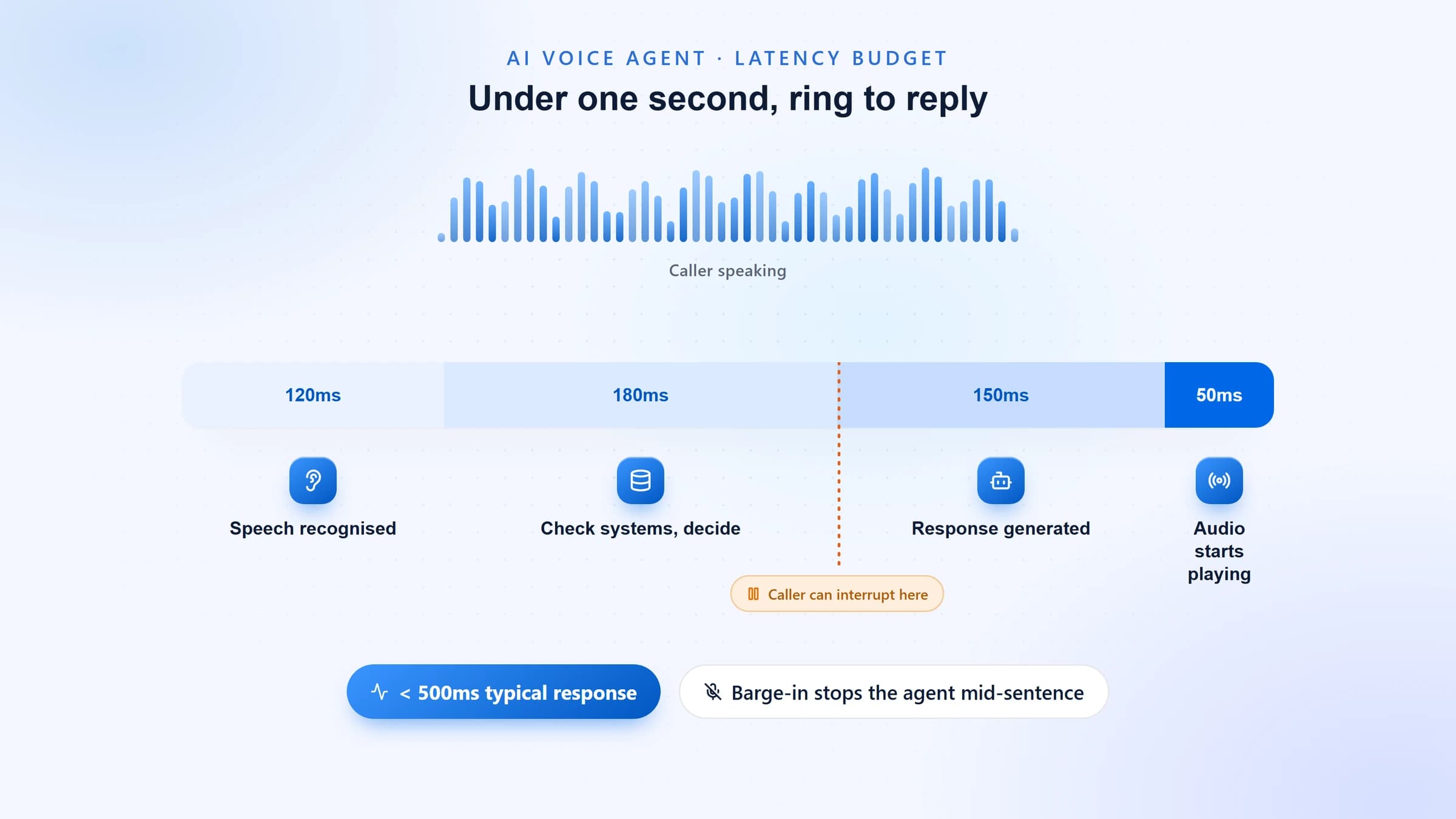
Interruptions, accents, silence, someone talking over the agent — an ai voice agent has to handle all of it in under a second, or the caller hangs up. Every part of the pipeline is chosen against the clock, from how fast speech is recognised to how soon the first audio reaches the caller.
AI voice agents for business: why private AI
Most voice AI projects do not fail in the demo. They fail in the security review. An agent that sends call recordings to a public model often cannot be approved, and a regulated business needs an audit trail, not just a good answer.
A dependable ai voice agent build has to pass security and legal review before a single call reaches it. So we settle the deployment first, then write the code.
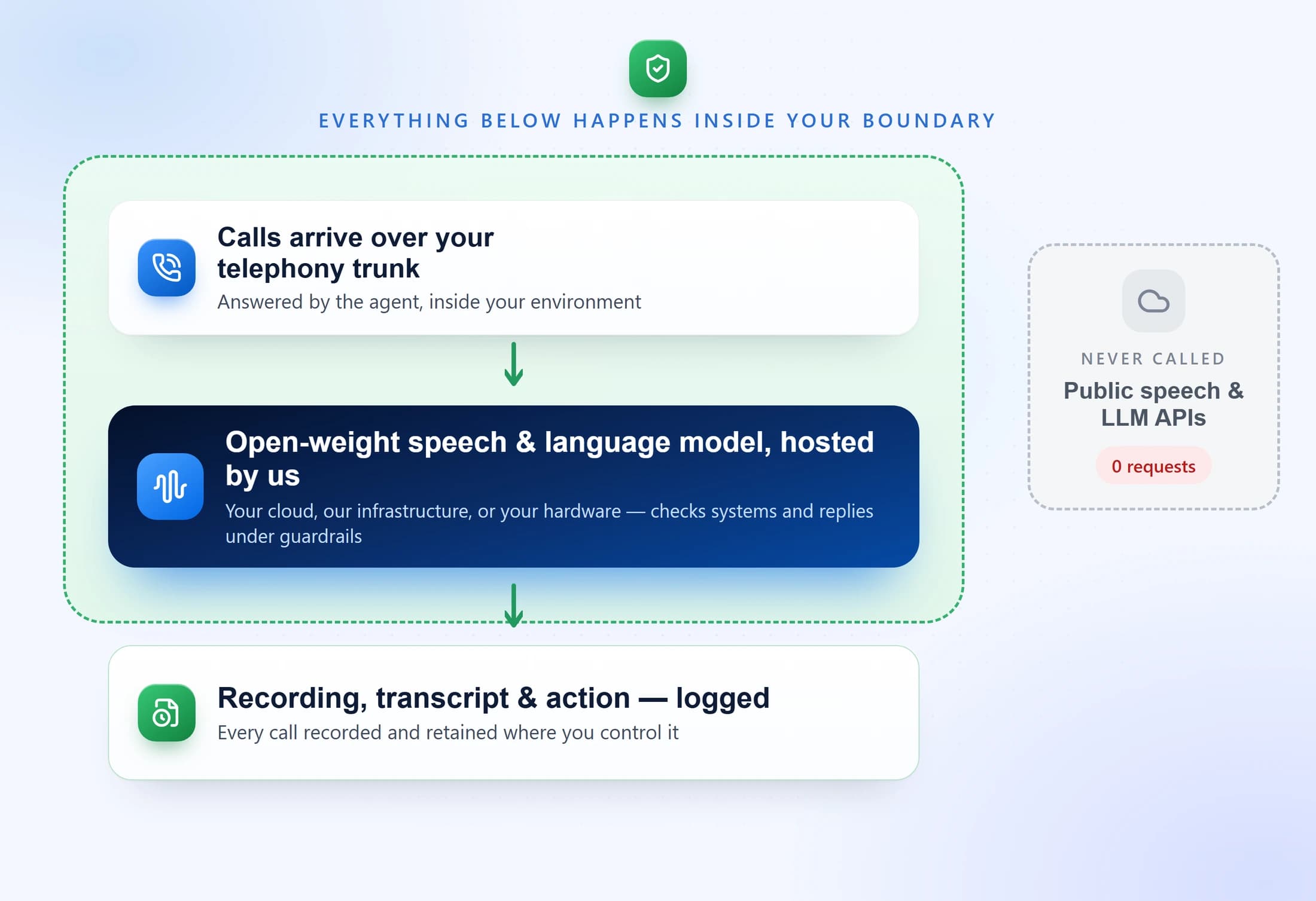
- Open-weight speech and language models that we host and tune ourselves
- Deployed in our infrastructure, in your cloud, or on your own hardware
- No calls out to a public LLM or speech API
- Every recording, transcript and action logged inside your environment
Voice ai platform or a dedicated build?
A voice ai platform suits a simple, low-risk call flow you can configure yourself. Custom voice ai agents earn their cost when the call is complex, the data is sensitive, or the workflow is yours alone — which is also where most voice ai companies stop being useful off the shelf.
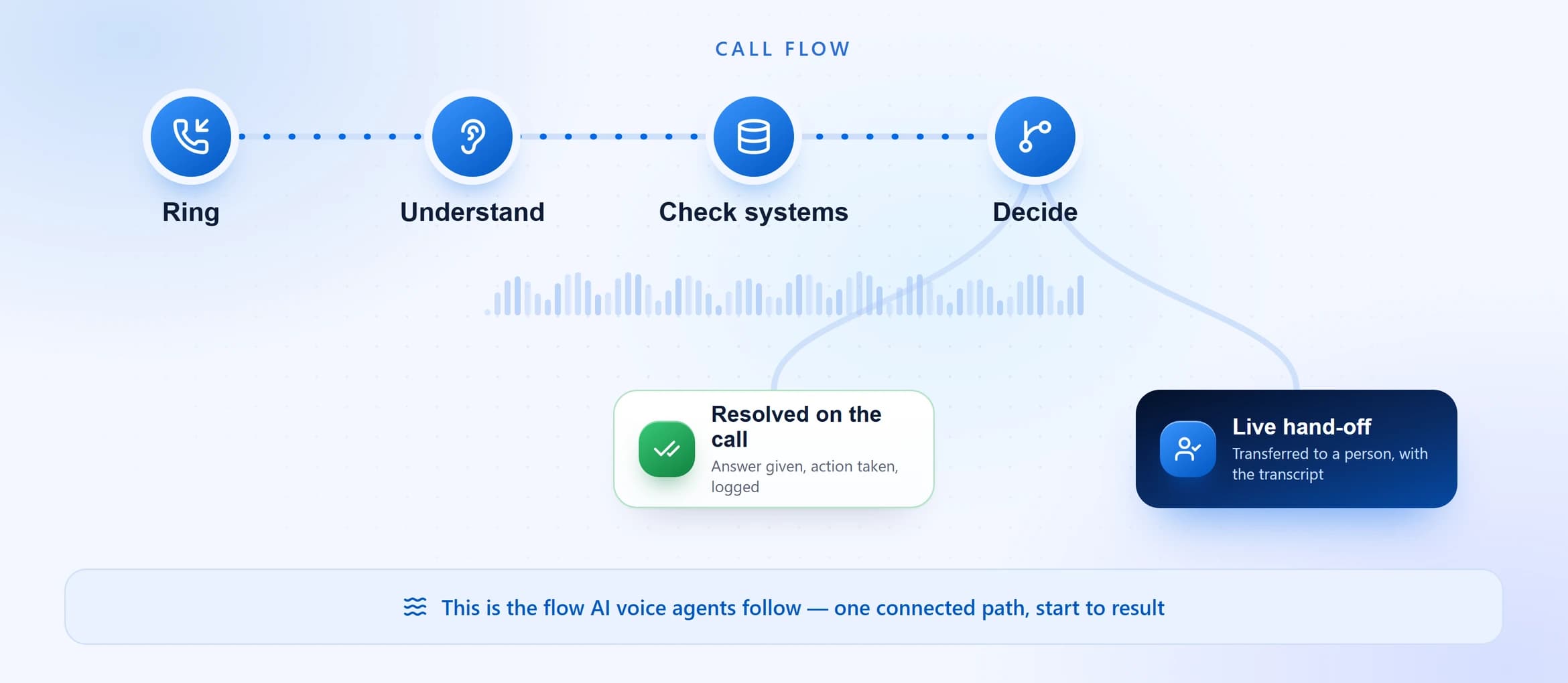
This is the flow AI voice agents follow
One connected path from the first ring to a result. The model is one step in it, not the whole thing — which is what makes a failure easy to find and a call easy to audit.
AI voice agent use cases across the business
These are the calls that usually justify building an agent. Each one starts as a single, well-defined call flow.
Runs the structured first round, follows up on thin answers, and produces a consistent written assessment for every candidate. This is what Vaani does in production today.
- Call
- Ask
- Follow up
- Assess
Answers routine enquiries, verifies identity against your systems, and escalates the calls that need a person.
- Call
- Verify
- Resolve
- Escalate
Voice automation for booking, rescheduling and reminder calls, reading and writing straight to your calendar system.
- Call
- Check calendar
- Book
- Confirm
Recorded calls transcribed and reviewed for quality, sentiment and compliance keywords, with a person reviewing what gets flagged — inside your own environment.
- Recording
- Transcribe
- Flag
- Review
The same ai voice agent, answering in the languages your callers actually use.
- Call
- Detect language
- Answer
- Log
Scores inbound calls against your criteria first, so a person spends time on the ones that matter.
- Call
- Score
- Qualify
- Hand off
An ai voice agent: proof, not promises
We do not publish invented numbers. Here is what we have built and run.
Vaani runs first-round screening interviews in production. It copes with interruptions and silence, and it writes the same kind of assessment for every candidate.
Read the case studyA support agent hosted entirely on private open-weight models, with every request logged for their compliance team — the same infrastructure a voice build runs on.
Read the case studyA field-sales routine rebuilt around capture at the source. The client reports a 3–4% increase in sales, and most of the gain came before any AI was involved.
Read the case studyCommon questions
Not answered here? Bring the question to a discovery call.
Book a discovery callAn AI voice agent is software that answers or makes phone calls, understands what the caller says, checks your systems, and either resolves the call or hands off to a person with the context attached. It differs from a phone tree because it holds an actual conversation, not a fixed menu of key presses.
No. An ai voice agent, a voice ai agent and voice ai agents all describe the same thing we build, just in a different word order. This page covers the full build breakdown, including how we handle barge-in and multilingual calls.
Not quite. Ai voice calling software usually just places or routes a call. An AI voice agent understands the conversation, checks your systems mid-call, and decides what to do — placing or answering the call is only the first step.
A voice ai platform is worth trying first for a simple, low-risk call flow you can configure yourself. It stops being enough once the call needs to check a real system, hold a real conversation, or meet a security review — that is where a custom build earns its cost.
Yes. The agent connects to your telephony over a voice call API, so it can sit behind the number you already use rather than requiring a new one.
Yes. Recorded calls can be transcribed and reviewed for quality, sentiment and compliance keywords, with the flagged calls routed to a person — running on the same private infrastructure as the agent itself.
Most voice ai companies sell a platform you configure yourself, with your audio passing through their hosted models. We build and run the agent for you, on private models, with the call flow designed around your systems rather than a generic template.
Screening interviews, inbound support and verification, appointment booking and reminders, multilingual support calls, and sales qualification calls are the voice ai solutions we build most often. Each one starts as a single, well-defined call flow.
Yes. The same agent can place calls for reminders, confirmations and follow-ups, not only answer them — voice automation that reads and writes to the same calendar or CRM system behind your inbound calls.
Yes. We host and tune open-weight speech and language models ourselves and deploy them in our infrastructure, in your cloud tenancy or on your own hardware. No call audio goes to a public API, and every request is logged inside the environment you approve.
A typical response is under 500 milliseconds. The budget breaks down as roughly 120 ms to recognise the speech, 180 ms to check your systems and decide, 150 ms to generate the response and 50 ms for the audio to start. If the caller talks over it, the agent stops mid-sentence and listens.
It hands the call off live to a person, with the transcript attached. Every recording, transcript and action is logged inside your environment.
Explore more capabilities
Tell us about the calls nobody has time to make.
A discovery session is a working conversation, not a demo. You will leave it knowing whether an ai voice agent is worth building, including if the answer is no.