
Enterprise AI agents that work the way your business does.
We design and build enterprise AI agents for the work your teams repeat every day: claims and exceptions, HR questions, support tickets and supplier follow-ups. Each agent plans the steps, reads your data, acts inside your systems, and hands off to a person when it should.
Every engagement starts with your process, not a template. We map it, connect it to your systems, and ship an agent your team actually uses.
Ai agents for enterprise use, connected to your ERP, CRM, HRIS and ticketing systems.
Agentic: it plans, acts and checks its own work — not a single-shot answer.
A person in the loop on the decisions that matter.
Can you check the status of claim #48213?
- PlanCheck the policy, then the claim history
- ActQuery the claims system
- ObserveA repair estimate is missing from the file
- DecideRequest the document, log the case
Claim #48213 is missing a repair estimate. I've requested it from the claimant and logged the case.
Enterprise AI agents for business operations, by vertical
The same agentic approach, applied to a different business context. Find the one that looks like your day — that's usually where it earns its cost first.
If you're the one chasing a missing repair estimate or flagging a claim that looks off, this is built for you: claims and underwriting agents read the policy and claim history together, flag what looks like fraud or a missing document, and update the case record themselves — instead of an adjuster retyping the same claim into three systems.
- Claim
- Check policy
- Flag exceptions
- Update record
If your day is visit notes, coverage checks and a CRM that's always a week behind, this is built for you: field and compliance agents turn a visit note or call report into a structured record and keep the CRM current — the same category of work behind our pharmaceutical field-sales engagement.
- Visit note
- Structure it
- Check compliance
- Update CRM
If you're the one untangling a stock mismatch, a stuck refund or a late shipment, this is built for you: order and returns agents check inventory, payment and shipping systems together, resolve the routine exceptions, and route the ones that need your judgement.
- Order exception
- Check systems
- Resolve
- Escalate
If your support queue never empties, this is built for you: support agents read the product documentation and the account's real state, then resolve or update the record themselves — including multilingual ai agents enterprise support teams can run across regions without a translation step.
- Ticket
- Check account
- Resolve
- Escalate
If you're answering the same leave and policy questions, or scheduling round-one interviews, this is built for you: agents answer policy and leave questions straight from the HR system, and can run a structured first-round screening call end to end. Decisions about hiring, pay and performance stay with you.
- Question
- HR system
- Answer or screen
- Person decides
If you're chasing a supplier for a missing certificate or reconciling a PO that doesn't match the invoice, this is built for you: procurement and supply-chain agents read supplier and inventory systems together, chase the missing paperwork, and bring a person in only for the exceptions that need judgement. Enterprise AI agents for transformation programmes usually start with one workflow like this, sized against real value before it expands.
- Exception
- Check suppliers
- Resolve
- Escalate
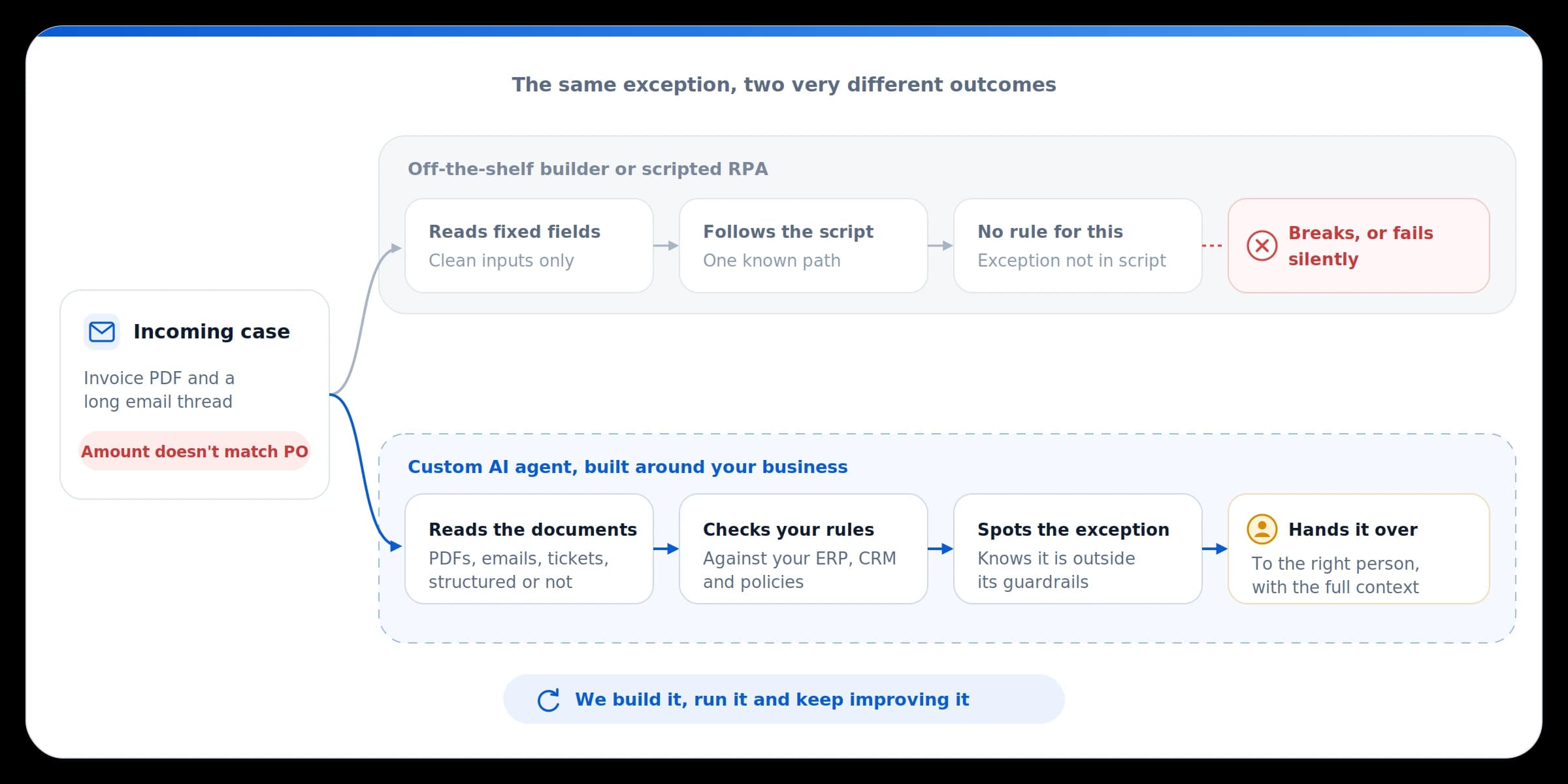
Custom AI agents, not an off-the-shelf builder
An off-the-shelf ai agent builder or a scripted RPA tool can wire up one tool call for one known path. Neither one adapts when the exception is not in the script — that is where a custom AI agent earns its cost.
A custom AI agent is built around your workflow, your data and your guardrails, not a generic template. It reads unstructured documents, tickets and messages, not just clean fields, recognises when a case is outside its guardrails, and hands off with context instead of breaking or failing silently.
What is an AI agent? (the Echnotek way)
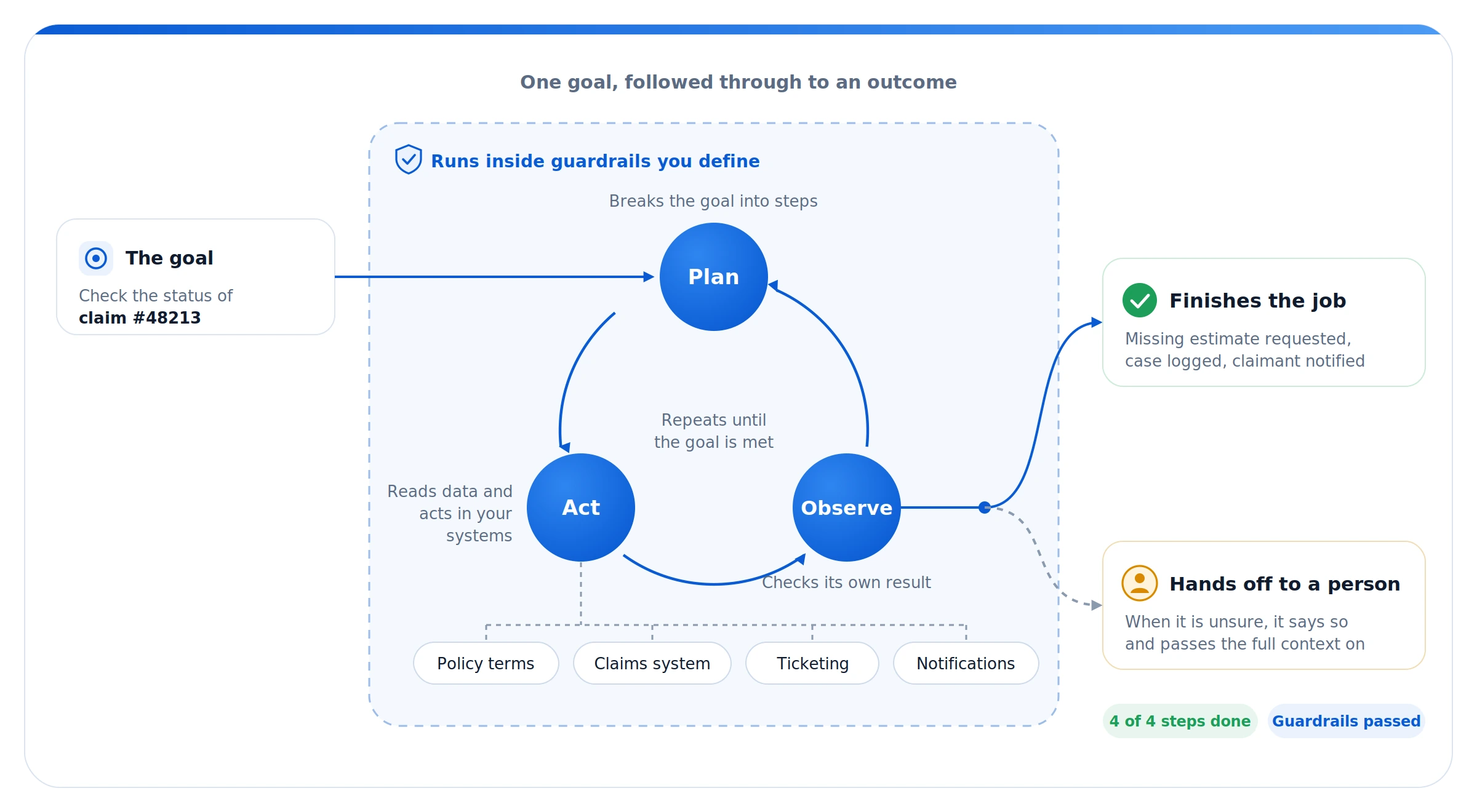
We won't waste your time defining an enterprise AI agent — you already know that part. What's different is how we build one: we start from the workflow your team already runs, not a template, and put a plan-act-observe loop around it, connected to your real systems, with guardrails you set and a person in the loop on the calls that matter.
An enterprise AI agents solution built to run privately
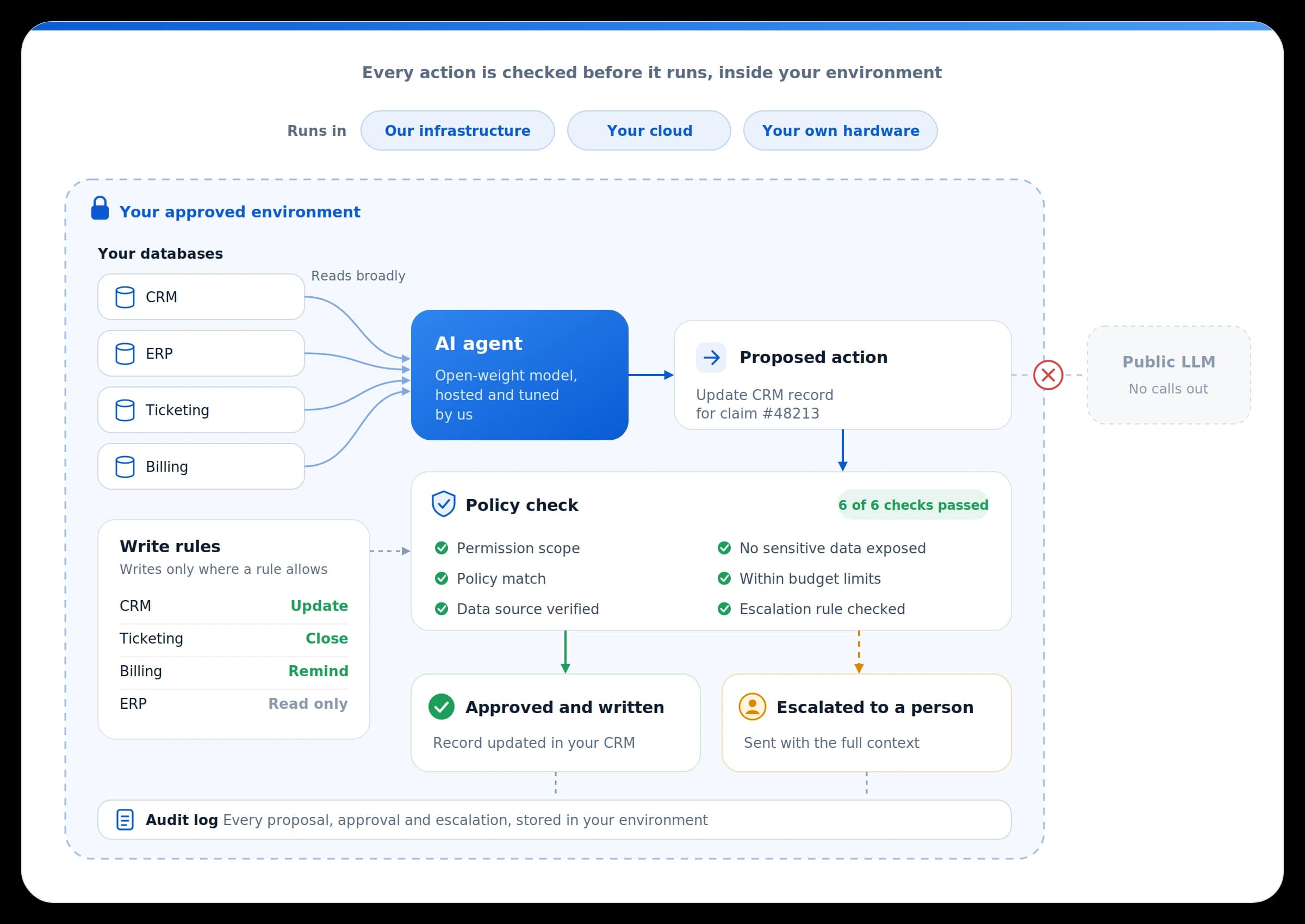
An agent that only answers is a data-privacy question. Ai agents enterprise teams actually put into production update a record, close a ticket or send a payment reminder — that is an authorization question too, and it needs a policy check and an audit trail, not just a good response.
Ai agents with enterprise databases behind them read broadly, and write only where a rule allows it. Every proposed action is checked before it runs, and every decision — approved or escalated — is logged inside the environment you approve.
Enterprise AI agents: proof, not promises
We do not publish invented numbers. Here is what we have built and run.
Built on the client's own documentation and past tickets. Connected to their support system. Hosted entirely on private open-weight models, with every request logged for their compliance team.
Read the case studyVaani runs first-round screening interviews in production. It copes with interruptions and silence. It writes the same kind of assessment for every candidate.
Read the case studyA field-sales routine rebuilt around capture at the source. The client reports a 3–4% increase in sales, and most of the gain came before any AI was involved.
Read the case studyCommon questions
Not answered here? Bring the question to a discovery call.
Book a discovery callAn AI agent is software that takes a goal, plans the steps, uses tools to act inside your systems, and checks its own result before deciding whether to continue, finish, or hand off to a person. Enterprise AI agents run that loop against real business systems, not a demo.
A generative model answers a single prompt and stops. An agentic AI agent plans a goal into steps, calls your tools and systems, observes what its own action actually did, and loops until the goal is met or it escalates. That loop — not the model alone — is what makes it agentic.
A chatbot returns text. Enterprise AI agents read your systems, take actions such as raising a ticket or updating a record, and hand over to a person with context. Every action passes a guardrail check first, and the decision is logged either way.
With one narrow, well-defined workflow — a claims queue, a support inbox, a screening call — connected to the systems that hold the truth. We size it, build it, measure it on real cases, then decide whether it is worth expanding.
Yes. We host and tune open-weight models ourselves and deploy them in our infrastructure, in your cloud tenancy or on your own hardware. No request goes to a public LLM, and every proposed action and decision is logged inside the environment you approve.
It depends on the business vertical and on how many systems the agent must reach. We start narrow, with one workflow, so you see real results early. A discovery session is the fastest way to get a scoped answer.
ERP, CRM, HRIS and ticketing systems are the most common. Depending on the workflow, that also includes claims and policy admin systems, order management, payment and shipping platforms, inventory databases, supplier portals, applicant tracking and calendar systems. Agents read broadly and write only where a rule allows it.
An off-the-shelf agent builder or a scripted RPA tool can wire up one tool call for one known path, but neither adapts when the exception is not in the script. A custom AI agent reads unstructured documents, tickets and messages, recognises when a case is outside its guardrails, and hands it over with context instead of failing silently. Most estates still need some rule-based automation too, and we will tell you honestly which parts are which.
Explore more capabilities
Tell us the workflow your team repeats every day.
A discovery session is a working conversation, not a demo. You will leave knowing whether an enterprise AI agent is worth building, including if the answer is no.