
Web scraping pulls pages. Beyond scraping, we extract structured data under legal preview.
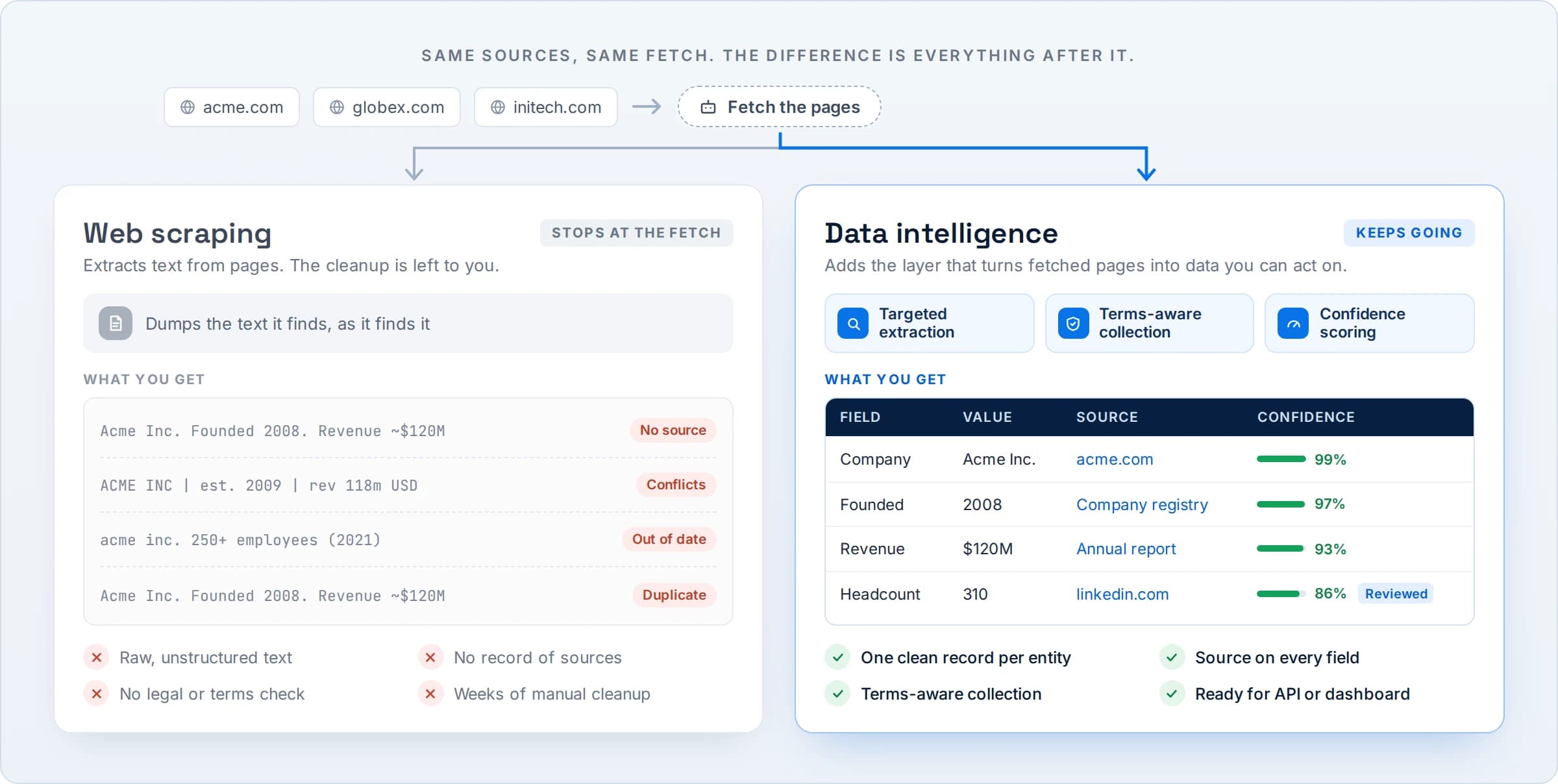
Web scraping just fetches pages. What has to happen around that fetch — for the numbers to be usable in a real business decision — is knowing which data points actually matter, checking whether a site's terms allow collection at all, tracing every figure back to its source, routing anything uncertain to a person, and scoring the confidence of every field before it reaches your dashboard.
We identify the specific data points that matter for your decision, not every field on the page.
Is web scraping legal for a given source? We check the terms before anything is collected — if they prohibit it, that source is handed to a person, not scraped anyway.
Every figure is traceable back to the exact page and timestamp it came from.
Ambiguous pages, blocked sources and low-confidence reads go to a person, not a guess.
Every field in every database carries a confidence score, so you know which numbers to trust and which to check before you act on them.
Web scraping pulls pages. Data Intelligence: Beyond Scraping delivers trusted, decision-ready data.
A generic scraper fetches pages and extracts text, which leaves you cleaning, deduping and verifying before anyone can use it. We build the layer around the fetch: targeted extraction, terms-aware collection, defined schemas, confidence scoring on every field, and human review where automated collection isn't allowed.
Web scraping, in plain terms
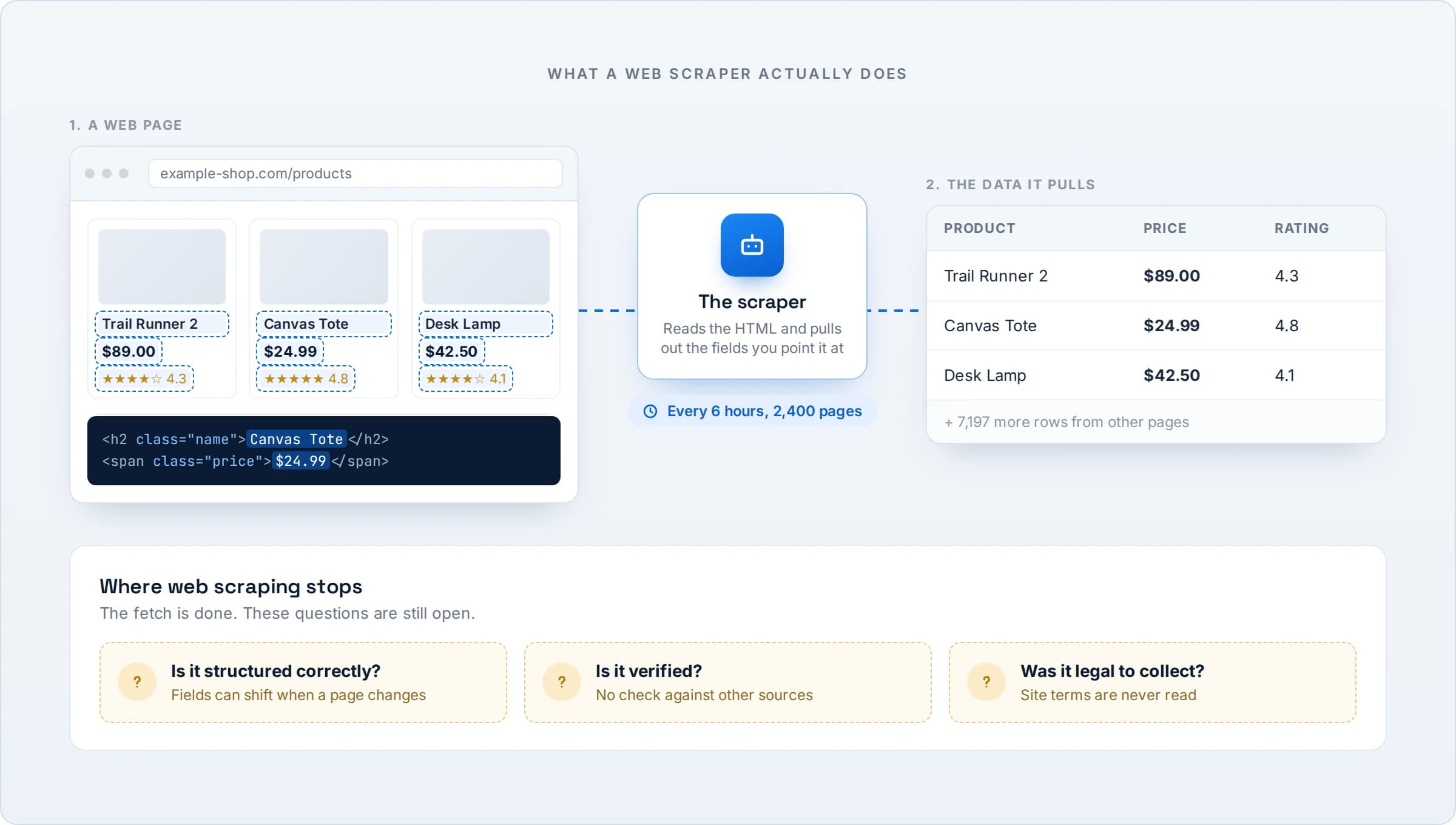
Web scraping means using software to pull data from web pages automatically, instead of a person copying it out by hand. The web scraping meaning stops right there, at the fetch — it says nothing about whether the data is structured, verified, or even legal to collect.
- Reads a page's HTML and pulls out the text, prices, listings or fields you point it at
- Runs on a schedule, across as many pages or sites as you need
- On its own, has no idea whether the data is structured correctly, verified, or even allowed
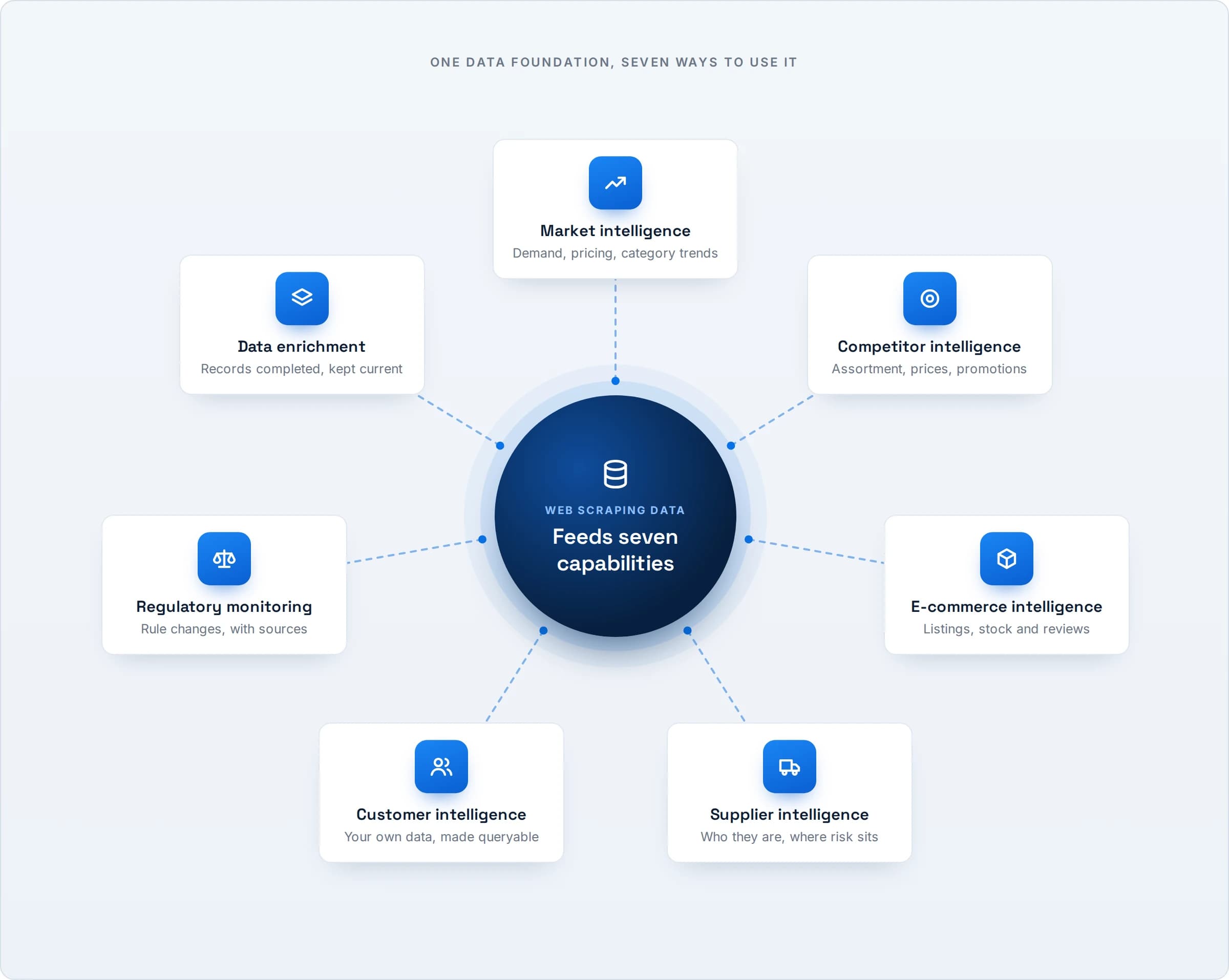
Seven problems, one capability
Demand, pricing and category movement tracked continuously — from google scraping of search results to scraping google maps for local listings — rather than surveyed once a year.
Assortment, price changes, promotions and positioning, monitored across the sites that matter.
Listings, stock, reviews and marketplace behaviour matched back to your own catalogue.
Who your suppliers are, what changed, and where concentration risk sits.
Rule changes in your markets, surfaced with the source they came from.
Your own transaction and behaviour data, structured so it can actually be questioned.
Existing records completed, corrected and kept current — including linkedin scraping for company and role data, where the terms allow it.
That is what discovery is for. Most engagements start with a question, not a specification.
A consulting partnership, not a signup
- 01Discovery
Two to three weeks. We work out which decisions are being made blind, what data exists, and what a useful answer would look like.
- 02Pilot
One narrow slice, run on your real sources. You see accuracy, provenance and confidence scores before anything scales.
- 03Production
The pipeline runs on a schedule, with human review where it earns its cost. We build and integrate the software the intelligence lives in — the dashboard, the API, the workflow.
- 04Hold accuracy
Sources change and sites break. We monitor, repair and keep the numbers trustworthy — that is the part most projects underestimate.
Two engagements
A design framework for payment-provider and merchant data at scale
- Context
- A global financial institution needing a current, consistent read on the payment landscape in one geography — which providers operate there, and which merchants accept which cards and methods.
- The problem
- The data existed, scattered across an enormous number of merchant and provider sources in no consistent shape. Assembling it by hand consumed analyst time on a scale that made refreshing the picture impractical, so decisions were made against a view that was already ageing.
- What we built
- The design framework first — what constitutes a provider record and a merchant profile, which fields matter, which sources are permitted, and how a value is judged reliable. Then governed web scraping and collection run against it, with provenance and confidence on every field, human review targeted where an error would change a decision, and merchant profiling delivered within the same engagement.
- Capabilities
- Framework designSource discoveryMerchant profilingProvenanceHuman-in-the-loopConfidence scoring
Our own web scraping and data intelligence pipeline
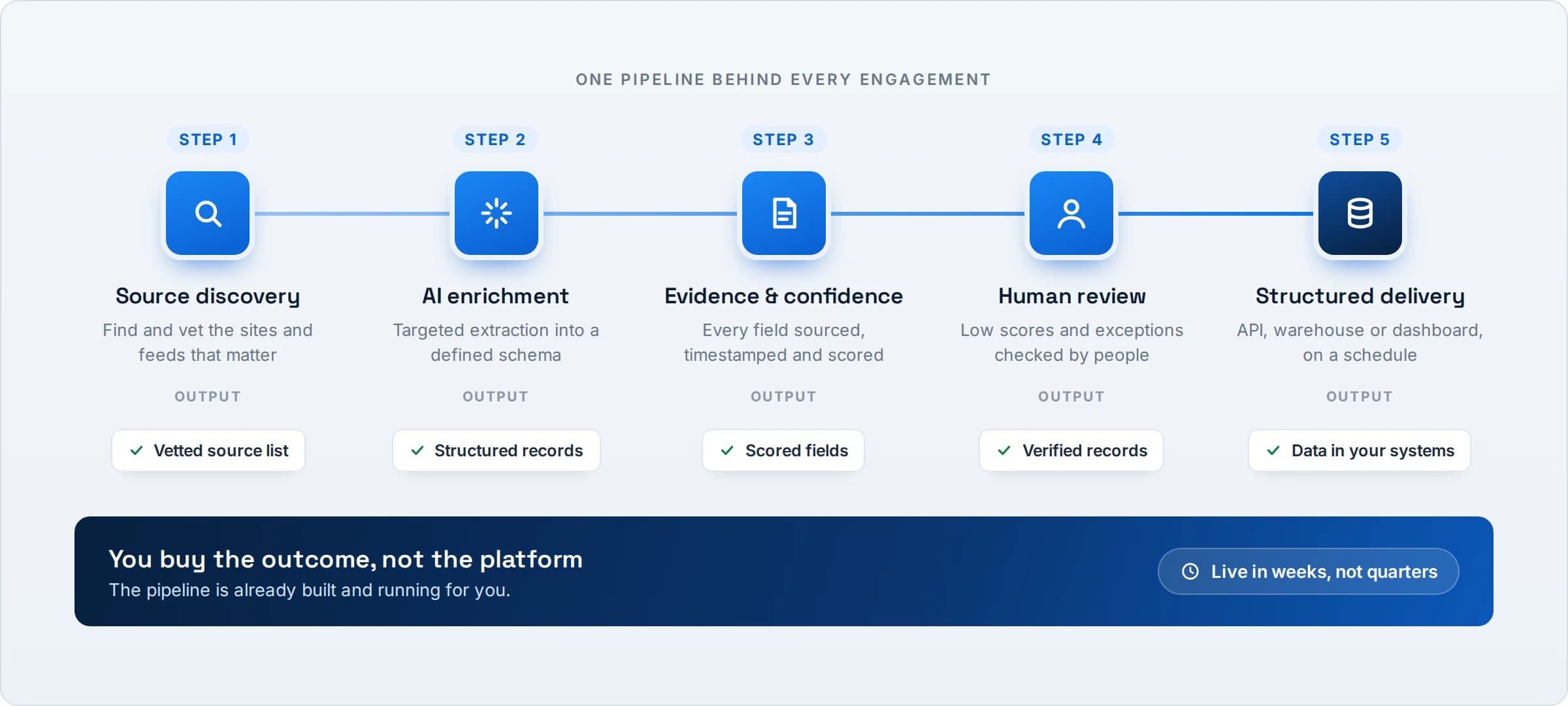
Every engagement runs on infrastructure we built and operate: governed source discovery and acquisition, AI enrichment, evidence and provenance on every field, confidence scoring, human review where it pays, and structured delivery into your systems.
You are not buying the platform. You are buying the outcome it makes possible — which is why we can start in weeks rather than quarters.
Common questions
It depends entirely on the source. Whether web scraping is legal for a given site comes down to that site's own terms, what data is being collected, and where you and the site sit legally. We check the terms before we automate collection from any source — if they prohibit it, that source goes to a person, not a scraper.
Where an engagement calls for it, yes — the structured, confidence-scored data can be delivered as a scraping API instead of a dashboard or file export. We are not a self-serve scraping API you sign up for and configure yourself; if that is what you need, a best web scraping api product off the shelf may suit you better. We are built for teams who need governed collection, provenance and confidence scoring behind the API.
Our own platform, and most of it is written using web scraping python — the common toolset behind targeted extraction, scheduling and schema-defined parsing. We can also hand over the code and schemas if you want to run parts of it yourselves.
Yes. Scraping google maps for local listings and google scraping of search results are common sources inside a market or competitor intelligence engagement. We treat both the same as any other source: terms checked first, then targeted, scheduled collection with provenance on every field.
We can, where a client's own use case and the source's terms allow it. LinkedIn is one of the more restrictive sources, so this is usually scoped carefully during discovery rather than assumed.
Check the terms before collecting. Extract only the fields the decision actually needs. Keep provenance on every value. Score confidence instead of assuming accuracy. Route the exceptions to a person. Those five are the web scraping best practices this whole page is built around.
Most web scraping services stop at delivery — you get a file of extracted pages and do the cleaning, verifying and structuring yourself. We do that layer as part of the engagement: schemas, confidence scores, provenance and human review, delivered into your systems.
Discovery takes two to three weeks. Then a pilot runs one narrow slice on your real sources, so you see accuracy, provenance and confidence scores before anything scales. After that, the pipeline runs in production on a schedule.
Sources change and sites break, so we monitor, repair and keep the numbers trustworthy as an ongoing part of the engagement. Ambiguous pages, blocked sources and low-confidence reads go to a person rather than a guess.
Explore more capabilities
Bring us a decision you are making without enough information.
A discovery session is a working conversation, not a demo. You will leave it knowing whether this is worth doing — including if the answer is no.